Validated Architectures
This page presents only LBMNet architectures that have been implemented, experimentally evaluated, or formally described in our research work.
Each listed architecture is accompanied by its application, lattice configuration, implementation status, experimental results, and available research resources.
Architectures that are still under development are clearly identified as experimental and are not presented as validated models.
Featured Architecture
Highlighting the latest validated DEEPLBMNet architecture.

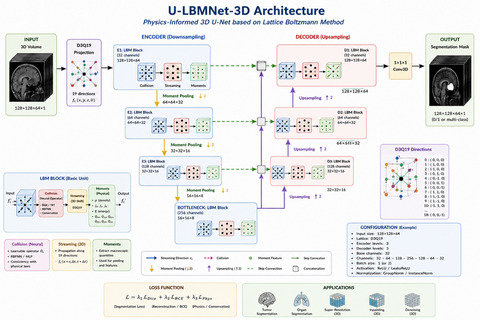
- U- LBMNet: 3D Medical Image Segmentation
U-LBMNet is a three-dimensional physics-inspired encoder–decoder architecture for volumetric medical image segmentation. Inspired by the U-shaped network design and the Lattice Boltzmann Method (LBM), the model integrates trainable collision and streaming operators into a hierarchical multi-scale framework to accurately extract anatomical structures from volumetric medical images. The encoder progressively captures local and global contextual information, while the decoder reconstructs high-resolution segmentation maps through skip connections that preserve fine spatial details.
Unlike conventional 3D convolutional networks, U-LBMNet incorporates lattice-based feature propagation, moment transformations, and physics-inspired information flow to improve feature representation and spatial consistency throughout the segmentation process. This design enables efficient learning of complex three-dimensional anatomical patterns while maintaining computational efficiency and robustness.
The architecture is suitable for a wide range of volumetric imaging modalities, including Computed Tomography (CT), Magnetic Resonance Imaging (MRI), Cone-Beam CT (CBCT), and three-dimensional ultrasound. Typical applications include organ segmentation, tumor delineation, lesion detection, vessel segmentation, radiotherapy planning, surgical navigation, disease monitoring, and computer-assisted diagnosis.
U-LBMNet has been designed as a flexible framework that can be adapted to different clinical segmentation tasks by modifying the lattice configuration, encoder depth, decoder capacity, and attention mechanisms while preserving the core principles of the LBMNet family. Its modular design also facilitates the integration of advanced components such as Multiple-Relaxation-Time (MRT) operators, lattice attention modules, and multi-scale feature fusion strategies.
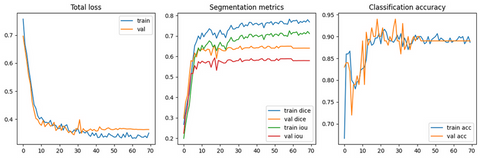
Curve of learning
Case: BRATS_001.nii.gz
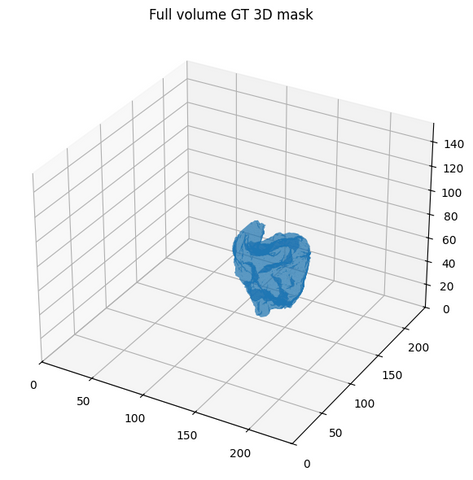
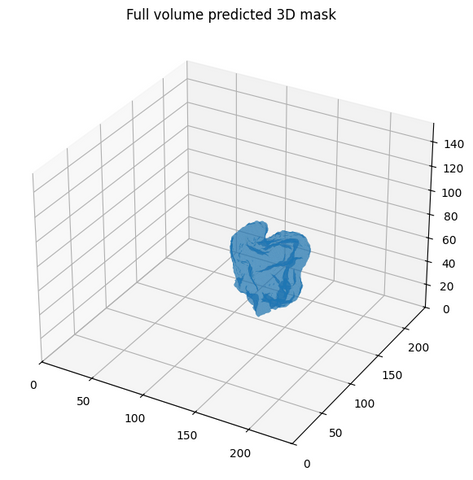
| GT class: 1 | Predicted class: 1 | Probabilities [no tumor, tumor]: [0.06287, 0.93713] | GT tumor voxels: 111,724 | Predicted tumor voxels: 115,862 | Dice: 0.848 | IoU: 0.736



Case: BRATS_004.nii.gz
| GT class: 1 | Predicted class: 1 | Probabilities [no tumor, tumor]: [0.06143, 0.93857] | GT tumor voxels: 120,660 | Predicted tumor voxels: 116,534 | Dice: 0.938 | IoU: 0.882



Construction 3D